Why Is Transport Plan Management Still So Painful?
Most operators manage their transport plans in spreadsheets or legacy GIS tools. A single stop move takes 2 hours; a seasonal overhaul 60–80 hours. GTFS validation errors generate AOM penalties.
2 hours per micro-adjustment
Adding a stop, shifting a departure time, or renaming a line triggers cascading edits across multiple files.
60–80 hours per seasonal overhaul
Summer/winter timetable changes require rebuilding calendars, re-exporting GTFS, and re-validating with regional authorities.
Non-compliant GTFS = AOM penalties
A missing required field or malformed stop_times.txt can block subsidy payments and break journey-planner feeds.
What Does Pysae Network Include?
Every feature is designed to cut the time between "we need to change the timetable" and "the new GTFS file is live."
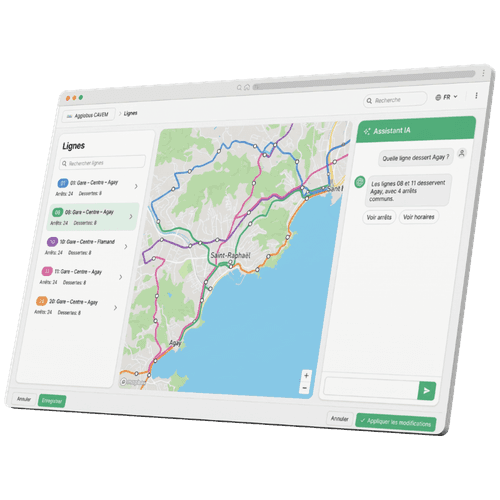
Map-based visual editor
Draw lines, position stops, and build trip patterns directly on a map — no spreadsheet, no SQL.
Natural-language AI agent
Describe changes in plain French or English: "Move stop 42 200 m north and update all trips on line 7." The agent validates, modifies, and flags conflicts.
Certified GTFS & NeTEx export
One-click export of AOM-compliant GTFS and NeTEx files. Compatible with Mobigo, BreizhGo, IDFM, and all major regional calculators.
Calendar & exception management
Handle school days, public holidays, special events, and seasonal timetables from a single calendar interface.
Multi-network & multi-agency
Manage several networks in one workspace. Delegate editing rights per network or per line to subcontractors.
Native Pysae Operations sync
Any change in Network propagates instantly to Operations real-time supervision — one database, zero re-import.
Measured ROI on Real Networks
Figures reported by Pysae clients 12 months after go-live.
Certified Integrations
Pysae Network exports directly to the regional journey-planner feeds and open-data portals that AOM authorities require.