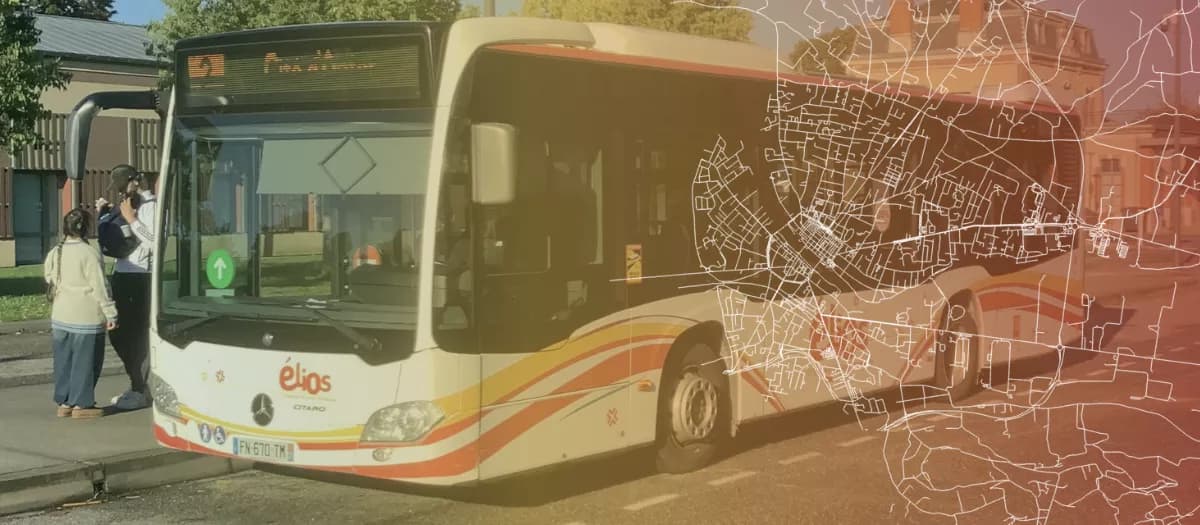
Transdev Grand Villeneuvois has run Réseau Elios in Villeneuve-sur-Lot since 2008, and the network has been fare-free since 2018. Since 2020, Pysae AVM gives drivers, dispatchers and passengers real-time information, and sensors count riders with 98.2% accuracy.
Just because a network is free-to-ride doesn't mean passengers expect any less. We had to maintain a high service standard: reliability, responsiveness and clear information at all times.
A fare-free network for 47,500 residents in 19 communes
Villeneuve-sur-Lot, in Lot-et-Garonne, has 47,500 residents across 19 communes, 14 of them rural. Réseau Elios combines regular lines, school transport, on-demand transport, paratransit (TPMR) and bike rental.
Why go fare-free when fares were 4% of revenue?
Fare-free travel became the rule in 2018 and was confirmed in 2020 after a review of the figures: ticket sales were only 4% of revenue, and reinstalling a ticketing system would have cost far more than it brought in.
- Versement mobilité (transport tax): 76% of the budget, €2.9M out of €3.8M
- Regional contribution for school transport: 23%
- A balanced budget, with no strain on public finances
How do you inform passengers without ticketing data?
Before 2020, passengers could not tell whether their bus had just left or was running late. Operations staff could not locate vehicles precisely or answer complaints quickly.
Real-time AVM across the whole Elios fleet
Since 2020, every bus carries Pysae Driver.
- Drivers follow their route live, talk to the control room and receive instructions in real time
- Dispatchers see the whole network instantly, and diversions or incidents are shared within seconds
- The Pysae passenger app shows real-time departures, and QR codes at stops locate the bus instantly
- More than 35,000 app connections a month within a few months, with no marketing campaign
Counting riders with 98.2% accuracy
To make up for the lack of ticketing data, every bus carries WeBreathe counting cells (98.2% accuracy). Their data is combined with Pysae data in monthly reports on ridership, punctuality, kilometres and service delivery. These reports drive decisions: peak-hour reinforcements, line extensions and school connection adjustments.
From BioGNV to 100% HVO by 2024
A BioGNV station opened in 2020, with compatible vehicles and staff training. In 2024, the whole fleet switched to HVO, a renewable fuel made from hydrotreated vegetable oils and produced locally from organic waste. The fleet is now 100% green.
Results: 956K trips a year, 35K app connections a month
- 956K trips per year
- 35K app connections per month
- 100% green fleet
- 98.2% passenger-count accuracy